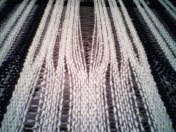
Just finished!
This warm color scarf has a double edge to it -- both sides have an overlapping "eyelash" that makes this funky and fun (of course).
Next up is a stylin' Open Reed neckpiece with a delicate over twist weft that has quite the personality.
In between all this, I really should be ordering parts for the J-Comp loom at Saunderstown Weaving School and writing my course proposals for the various weaver's seminar's for 2013. But weaving is so much more fun. And then there is the "Glove" project which I HAVE to get done for Tuesday Night's e-textile Lounge with Lynne Bruning! Sigh..........
Showing posts with label handweaving. Show all posts
December 4, 2011
July 1, 2011
MIZUGOROMO
When it's hot outside, it is time to weave "Water Cloth" (or mizugoromo in Japanese)!
Inspired by the patterns in Japanese Noh Costumes as seen in the link below: http://www.metmuseum.org/toah/works-of-art/2002.386
I am interpreting the pattern in this way.......
All silk -- some tussah (single ply) and 120/2 superfine.
When it's hot outside, it is time to weave "Water Cloth" (or mizugoromo in Japanese)!
Inspired by the patterns in Japanese Noh Costumes as seen in the link below: http://www.metmuseum.org/toah/works-of-art/2002.386
I am interpreting the pattern in this way.......
All silk -- some tussah (single ply) and 120/2 superfine.
June 9, 2011
Playing Spider
Installation piece for 3-day outdoor Flower Show.
Must withstand all types of weather.
Easy to install AND remove.
NOT the center of attention but part of a high-end design team.
![]() |
| Part I -- Prototype Center |
Installation piece for 3-day outdoor Flower Show.
Must withstand all types of weather.
Easy to install AND remove.
NOT the center of attention but part of a high-end design team.
Overall dimensions: 24" x 72" Realizations -- a spider has 8 hands, I have 2. Material: 8# test monofilament Method of construction: Crochet with one of the smallest crochet hooks in the world. (It came from my Great Grandmother.) Mantra: I can do it. I can do it. I am spider. |
June 16, 2010
Loomers, Weavers, and Gaiters
Preliminary Operations of Weaving
by Harry Nisbet, 1914
I LOVE reading encyclopedias, text books, and dictionaries. Especially technical books about weaving. It helps me define and refine my sense of self and my goals, hoping I will find a spot to fit in, somewhere in this huge world of humanity as an artist, weaver, and woman.
Preliminary Operatins of Weaving, by Harry Nisbet, Professor of Textiles (England), describes the processes inherent with the manufacture of cloth. While this might be dry reading for some, I find it fascinating! The descriptions and definitions he uses create a common language for students (and others) to follow. His descriptions give way to interpretation, which every good definition should. To wit: "If warp yarn is purchased in any of the primary forms ..... its progress through the entire routine of manufacture into cloth (exclusive of bleaching, dying, and other incidental processes) essentially comprises a series of not more than EIGHT consecutive operations, which are performed in the following rotation:
Preliminary Operations of Weaving
by Harry Nisbet, 1914
I LOVE reading encyclopedias, text books, and dictionaries. Especially technical books about weaving. It helps me define and refine my sense of self and my goals, hoping I will find a spot to fit in, somewhere in this huge world of humanity as an artist, weaver, and woman.
Preliminary Operatins of Weaving, by Harry Nisbet, Professor of Textiles (England), describes the processes inherent with the manufacture of cloth. While this might be dry reading for some, I find it fascinating! The descriptions and definitions he uses create a common language for students (and others) to follow. His descriptions give way to interpretation, which every good definition should. To wit: "If warp yarn is purchased in any of the primary forms ..... its progress through the entire routine of manufacture into cloth (exclusive of bleaching, dying, and other incidental processes) essentially comprises a series of not more than EIGHT consecutive operations, which are performed in the following rotation:
- Reeling yarn into hanks
- Winding yarn on to warpers' bobbins
- Warping
- Sizing
- Beaming -- winding warps finally on to weavers' beams
- Looming -- to pass the warp threads through the shedding harness and reed (a. Drawing-in, b.Twisting, c. Tying)
- Gaiting or Tuning -- preparing the warp, shedding harness, and the loom ready for weaving
- Weaving
Of these eight operations, the first five and last (weaving) are performed mechanically. The sixth (looming) is generally accomplished by hand, although both drawing-in and twisting (or else tying) are sometimes performed by automatic mechanical appliances...... The seventh operation, however (Gaiting) comprises numerous incidental functions, which necessarily demand personal labour and skill, in the proper adjusting and timing of the various parts of the loom and its accessories....."
So, in light of this definition, Who am I? A loomer, weaver, or gaiter?
March 24, 2010

The Open ReedTM
Having given myself the freedom to explore and create, I have found a bit of success! There are still some ways to tweak this technique, but for the most part, I have found a great rhythm in using an open Reed.

By letting the fabric speak for itself, I am hoping the textile will initiate a response of shared process, shared quest, shared interest with a viewer. I don't know how long this fabric will be, but I have a beginning.
December 17, 2009

BEFORE THE CUT......
As a special favor to me, Vivian, tailor extrordinaire, took these pictures of the material I wove for Keith's Vest. This vest is his wedding present from me even though I expect him to wear it to the wedding. giggle giggle.
It has a beautiful drape and I am so excited to get the final product. I have lightly finished the 5 yards of cloth. Found the perfect silk for the lining and back. And even though Vivian
used less than 2 yards of the cloth, I still wove off the whole length. The remainder will be used for samples for the next Guild Newsletter.

For the technically curious, I used 10/2 mercerized cotton warp sett at 24 epi. Threading is a Two-Fold M's & O's one of my favorite patterns because it is so diverse. Check out Margarite Davidson's book for exact threading options using this structure. Weft is a superfine wool (3600 yds/lb). Beat is almost balanced at 28 ppi.
December 9, 2009
Gallinger Loom
Way back in 1982 when I started

weaving, I was using a "Lillistina" Loom from Sweden. It had string heddles and an "X" style construction. Everything on it was string. I bought the loom because I was fascinated with weaving, but I didn't know how to set it up or do anything. I had no "vocabulary" for weaving, but I did have a handout from the woman I bought the loom from that listed the steps I needed to do in order to warp the loom. What fun.....
About three months into loom ownership, I was in a craft store in Ogden, Utah (where we were living at the time) and I found a Dover Publication titled "The Joy of Handweaving" by Osma Gallinger Tod. This book became my EVERYTHING. I treasured this book -- it had a history of weaving, an explanation of looms and the tools necessary for weaving, projects, drafts, weave structures, and problem solving. I became dependent upon this book in my winter isolation on the

Wasatch Mountain range and I devoured this book cover to cover many times over. And Osma Gallinger Tod became very real to me -- she was my hero, even though I knew nothing about her other than she authored the book I learned to weave from.
Fast forward 25 years of weaving devotion later to last week at the Saunderstown Weaving School where I am given the opportunity to rebuild THE loom that Osma Gallinger Tod wove on. Her husband built this and many others like it. It was part of her business. Osma passed this loom onto her niece, who in turn, donated it to the school. I was almost crying with reverence and excitement as this beautiful machine is put together. It is 8 harness, 14 treadle, high castle "jack" style action. Norma will be the first one to weave on it and we are planning Summer and Winter project. I can't wait!
August 13, 2009
Nappy's Butterflies

A woman at the weaving school (Saunderstown Weaving school that is) had to leave for the summer and left her 20/2 olive cotton warp on one of the looms threaded to Nappy's Butterflies -- an overshot pattern found in Marguerite Davidson's Handweaver's Pattern Book (1944). I took over the warp after Barbara's project came off and decided to work with a Honeycomb treadling. I am using a fine blue bamboo weft with a heavier and darker blue/green wool for the honeycomb thread. I looks just like blue butterflies! I can't wait to see the piece once it has been gently finished!

It is interesting how the best made plans.....don't always work out. The beautiful cloth I was weaving a few weeks ago with the natural silk cocoons layered between fine merino wool and held in place with another type of silk, didn't work out. Glad I captured the idea with a photo. The problem was the sett on the layers 3 and 4. Layers 1 and 2 were sett @ 10 epi. Layers 3 and 4 were sett further apart -- approx. 6 epi. I did this to create a felted movement in the final piece.
Again, great in theory, but not in practice. The final scarf has incredible drabe and texture, but not what I was planning. The final product will be my next post. But in the meantime, check this out:

A woman at the weaving school (Saunderstown Weaving school that is) had to leave for the summer and left her 20/2 olive cotton warp on one of the looms threaded to Nappy's Butterflies -- an overshot pattern found in Marguerite Davidson's Handweaver's Pattern Book (1944). I took over the warp after Barbara's project came off and decided to work with a Honeycomb treadling. I am using a fine blue bamboo weft with a heavier and darker blue/green wool for the honeycomb thread. I looks just like blue butterflies! I can't wait to see the piece once it has been gently finished!
July 20, 2009
New England Weavers Seminar
A beautiful sunny day to work in the garden! But first, let me share with you my recent adventures.
I have just returned from the New England Weavers Seminar hosted at Smith College in North Hampton, MA. What a treat to see the work of other New Engalnd handweavers. I had two pieces in the Gallery exhibit and one triple layer weave (with copper, silk, wool, tencel) in the special exhibit "Imagination Unleashed". The work coming out of the MFA students at RISD and UMass Dartmouth is incredible! Fiber optic LED cables, wire, aluminum strips, saran wrap, paper, and the like, used in wall sculpture, upholstery, and clothing.
The fashion show had some interesting double weave, collapse weave, and of course, highly tailored jackets. But my favorite was a delicate and simple vest by Adelle Harvey that was handspun from paper and woven on a linen warp. Another piece of hers (a plain weave table mat) was in the Gallery exhibit and was spun from newspaper.
Sarah Fortin from New Hampshire has some incredible yardages using a double layer and supplementary warp technique.
I am inspired to get back into the studio (after I play in the garden) and finish up the warps I have on the looms. One is a natural 20/2 perle cotton threaded in a 4H M's and O's variation with a fine merino and linen weft. This is the fabric for my wedding shawl with a matching vest for Keith. (He even said he would model his for the next NEWS Fashion Show).
Subscribe to:
Posts (Atom)