A great article about Saunderstown Weaving School
Saunderstown, Rhode Island
pages 63 - 67
http://digital.designnewengland.com/designnewengland/2012012?pg=63&pm=2&u1=texterity&linkImageSrc=%2Fdesignnewengland%2F2012012%2Fdata%2Fimgpages%2Ftn%2F0063_icqgkx.gif%2F#pg63
Showing posts with label suzi ballenger. Show all posts
Showing posts with label suzi ballenger. Show all posts
January 6, 2012


December 4, 2011

This warm color scarf has a double edge to it -- both sides have an overlapping "eyelash" that makes this funky and fun (of course).
Next up is a stylin' Open Reed neckpiece with a delicate over twist weft that has quite the personality.
In between all this, I really should be ordering parts for the J-Comp loom at Saunderstown Weaving School and writing my course proposals for the various weaver's seminar's for 2013. But weaving is so much more fun. And then there is the "Glove" project which I HAVE to get done for Tuesday Night's e-textile Lounge with Lynne Bruning! Sigh..........
September 5, 2011
Not many photos, but I do have fun stuff to share.....
I will be presenting for the Weaver's Guild of Rhode Island at Slater Mill Museum on Firday October 7, 2011 at 10:30 am. Topic is Equipment Modification and The Open Reedtm. We will explore the different ways to easily "modify" our looms and attachments and equipment to achieve structural and decorative effects in cloth.
Oh, and did I mention:
I will be presenting for the Weaver's Guild of Rhode Island at Slater Mill Museum on Firday October 7, 2011 at 10:30 am. Topic is Equipment Modification and The Open Reedtm. We will explore the different ways to easily "modify" our looms and attachments and equipment to achieve structural and decorative effects in cloth.
Oh, and did I mention:
 |
| Tree Roots Close-up |
 |
| Blue Ridge Mtn. Tree Roots with Awards! |
July 1, 2011
MIZUGOROMO
When it's hot outside, it is time to weave "Water Cloth" (or mizugoromo in Japanese)!

Inspired by the patterns in Japanese Noh Costumes as seen in the link below: http://www.metmuseum.org/toah/works-of-art/2002.386
I am interpreting the pattern in this way.......
All silk -- some tussah (single ply) and 120/2 superfine.

When it's hot outside, it is time to weave "Water Cloth" (or mizugoromo in Japanese)!

Inspired by the patterns in Japanese Noh Costumes as seen in the link below: http://www.metmuseum.org/toah/works-of-art/2002.386
I am interpreting the pattern in this way.......
All silk -- some tussah (single ply) and 120/2 superfine.

June 28, 2011


June 9, 2011
Playing Spider
Installation piece for 3-day outdoor Flower Show.
Must withstand all types of weather.
Easy to install AND remove.
NOT the center of attention but part of a high-end design team.
 |
| Part I -- Prototype Center |
Installation piece for 3-day outdoor Flower Show.
Must withstand all types of weather.
Easy to install AND remove.
NOT the center of attention but part of a high-end design team.
Overall dimensions: 24" x 72" Realizations -- a spider has 8 hands, I have 2. Material: 8# test monofilament Method of construction: Crochet with one of the smallest crochet hooks in the world. (It came from my Great Grandmother.) Mantra: I can do it. I can do it. I am spider. |
May 31, 2011
An Apron for an Electronic Scarf (see previous post)
My next newest favoritest fiber -- Angelina! And my latest discovery/realization? Saran does NOT need to be stitched to stick together -- medium heat works best!
 You may see this close up at THE WORLDS SMALLEST GALLERY, Peace Dale Art Park, Peace Dale, RI from June 1 - July 17, 2011. I will have a few other works on display that focus on re-cycled, re-used, and re-purposed fibers!
My next newest favoritest fiber -- Angelina! And my latest discovery/realization? Saran does NOT need to be stitched to stick together -- medium heat works best!

April 28, 2011
Electronic Scarf
I must admit this is not a new idea -- I have been inspired for a number of months by eTextile artist Lynne Bruning (www.lbruning.com), but for me it is AWESOME! I have NO background in electronics, electricity, or connectivity. Yet, Lynne's INSTRUCTABLES and website totally made me do it! Yes, Lynne, I am blaming you for all this creativity bursting out of my head and hands!

What I have done is use 3 different weft leads. Two of those leads, contain conductive thread. One of the leads is insulating (contains no conductivity) to prevent the - and + side of the LEDs to touch. The difficulty is in attention to keeping Positive to Positive on the + Weft Lead and the Negative to Negative on the - Weft Lead. And I used the same dark blue wool and nylon ribbon weft for the neutral insulating lead. My son, Dillon, helped me write a schematic diagram to help keep all the leads straight. It is quite simple once you draw it out. Just remember to always keep the +'s on the same side and the -'s on a different side. Mark your beginning and ending leads when you start.
Now, how is all this going to be "hooked up"? With a 3V coin battery and battery holder that I bought at Radio Shack! And what makes the final charge? A simple clothing snap or hook and eye. I will put a decorative button on the outside of the scarf on the opposite side of the female part and the battery with the male part of the snap will go on the other end. When the scarf is snapped closed -- the LEDs will shine shine shine!
I must admit this is not a new idea -- I have been inspired for a number of months by eTextile artist Lynne Bruning (www.lbruning.com), but for me it is AWESOME! I have NO background in electronics, electricity, or connectivity. Yet, Lynne's INSTRUCTABLES and website totally made me do it! Yes, Lynne, I am blaming you for all this creativity bursting out of my head and hands!
What I have done is use 3 different weft leads. Two of those leads, contain conductive thread. One of the leads is insulating (contains no conductivity) to prevent the - and + side of the LEDs to touch. The difficulty is in attention to keeping Positive to Positive on the + Weft Lead and the Negative to Negative on the - Weft Lead. And I used the same dark blue wool and nylon ribbon weft for the neutral insulating lead. My son, Dillon, helped me write a schematic diagram to help keep all the leads straight. It is quite simple once you draw it out. Just remember to always keep the +'s on the same side and the -'s on a different side. Mark your beginning and ending leads when you start.
Now, how is all this going to be "hooked up"? With a 3V coin battery and battery holder that I bought at Radio Shack! And what makes the final charge? A simple clothing snap or hook and eye. I will put a decorative button on the outside of the scarf on the opposite side of the female part and the battery with the male part of the snap will go on the other end. When the scarf is snapped closed -- the LEDs will shine shine shine!
June 16, 2010
Loomers, Weavers, and Gaiters
Preliminary Operations of Weaving
by Harry Nisbet, 1914
I LOVE reading encyclopedias, text books, and dictionaries. Especially technical books about weaving. It helps me define and refine my sense of self and my goals, hoping I will find a spot to fit in, somewhere in this huge world of humanity as an artist, weaver, and woman.
Preliminary Operatins of Weaving, by Harry Nisbet, Professor of Textiles (England), describes the processes inherent with the manufacture of cloth. While this might be dry reading for some, I find it fascinating! The descriptions and definitions he uses create a common language for students (and others) to follow. His descriptions give way to interpretation, which every good definition should. To wit: "If warp yarn is purchased in any of the primary forms ..... its progress through the entire routine of manufacture into cloth (exclusive of bleaching, dying, and other incidental processes) essentially comprises a series of not more than EIGHT consecutive operations, which are performed in the following rotation:
Preliminary Operations of Weaving
by Harry Nisbet, 1914
I LOVE reading encyclopedias, text books, and dictionaries. Especially technical books about weaving. It helps me define and refine my sense of self and my goals, hoping I will find a spot to fit in, somewhere in this huge world of humanity as an artist, weaver, and woman.
Preliminary Operatins of Weaving, by Harry Nisbet, Professor of Textiles (England), describes the processes inherent with the manufacture of cloth. While this might be dry reading for some, I find it fascinating! The descriptions and definitions he uses create a common language for students (and others) to follow. His descriptions give way to interpretation, which every good definition should. To wit: "If warp yarn is purchased in any of the primary forms ..... its progress through the entire routine of manufacture into cloth (exclusive of bleaching, dying, and other incidental processes) essentially comprises a series of not more than EIGHT consecutive operations, which are performed in the following rotation:
- Reeling yarn into hanks
- Winding yarn on to warpers' bobbins
- Warping
- Sizing
- Beaming -- winding warps finally on to weavers' beams
- Looming -- to pass the warp threads through the shedding harness and reed (a. Drawing-in, b.Twisting, c. Tying)
- Gaiting or Tuning -- preparing the warp, shedding harness, and the loom ready for weaving
- Weaving
Of these eight operations, the first five and last (weaving) are performed mechanically. The sixth (looming) is generally accomplished by hand, although both drawing-in and twisting (or else tying) are sometimes performed by automatic mechanical appliances...... The seventh operation, however (Gaiting) comprises numerous incidental functions, which necessarily demand personal labour and skill, in the proper adjusting and timing of the various parts of the loom and its accessories....."
So, in light of this definition, Who am I? A loomer, weaver, or gaiter?
March 24, 2010

The Open ReedTM
Having given myself the freedom to explore and create, I have found a bit of success! There are still some ways to tweak this technique, but for the most part, I have found a great rhythm in using an open Reed.
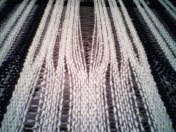
By letting the fabric speak for itself, I am hoping the textile will initiate a response of shared process, shared quest, shared interest with a viewer. I don't know how long this fabric will be, but I have a beginning.
March 13, 2010

The Reed Project
Since moving my studio home, I have been feeling disappointed with the situation. So I have challenged myself with a following through on a desire I have had in the back of my mind for a few years now -- manipulating the weft threads without using the heddles. Inspired by the Macrogauze series of Peter Collingwood's, I had a friend cut off the top of a 12 dent reed for me so I can move threads across the web in front of the reed. It works, but only for a few threads at a time -- no more than 4 can cross or you will be stuck with no shed to weave with. The structure is like a leno lace.
I also have figured out how to "pinch" the tops of the dents to create a modified fan! Eventually I will be able to create a false ondule`! I need to figure out a way to move the beater up and down to do that. I tried raising the warp threads on the back of the loom, but since I am using a jack loom, all that does is make it harder to weave by raising the heddles! (of course!)
After I am done sampling with this idea, check out my next lesson:

Yes, those are individual reed sections about 2 1/2 inches wide each. We will have to see how they help create spaces in the warp!
Ann Sutton's books, "Ideas in Weaving" and "The Structure of Weaving" along with the book, "Falcots Weave Compendium" are quite helpful.
December 17, 2009

BEFORE THE CUT......
As a special favor to me, Vivian, tailor extrordinaire, took these pictures of the material I wove for Keith's Vest. This vest is his wedding present from me even though I expect him to wear it to the wedding. giggle giggle.
It has a beautiful drape and I am so excited to get the final product. I have lightly finished the 5 yards of cloth. Found the perfect silk for the lining and back. And even though Vivian
used less than 2 yards of the cloth, I still wove off the whole length. The remainder will be used for samples for the next Guild Newsletter.

For the technically curious, I used 10/2 mercerized cotton warp sett at 24 epi. Threading is a Two-Fold M's & O's one of my favorite patterns because it is so diverse. Check out Margarite Davidson's book for exact threading options using this structure. Weft is a superfine wool (3600 yds/lb). Beat is almost balanced at 28 ppi.
December 9, 2009
Gallinger Loom
Way back in 1982 when I started
weaving, I was using a "Lillistina" Loom from Sweden. It had string heddles and an "X" style construction. Everything on it was string. I bought the loom because I was fascinated with weaving, but I didn't know how to set it up or do anything. I had no "vocabulary" for weaving, but I did have a handout from the woman I bought the loom from that listed the steps I needed to do in order to warp the loom. What fun.....
About three months into loom ownership, I was in a craft store in Ogden, Utah (where we were living at the time) and I found a Dover Publication titled "The Joy of Handweaving" by Osma Gallinger Tod. This book became my EVERYTHING. I treasured this book -- it had a history of weaving, an explanation of looms and the tools necessary for weaving, projects, drafts, weave structures, and problem solving. I became dependent upon this book in my winter isolation on the
Wasatch Mountain range and I devoured this book cover to cover many times over. And Osma Gallinger Tod became very real to me -- she was my hero, even though I knew nothing about her other than she authored the book I learned to weave from.
Fast forward 25 years of weaving devotion later to last week at the Saunderstown Weaving School where I am given the opportunity to rebuild THE loom that Osma Gallinger Tod wove on. Her husband built this and many others like it. It was part of her business. Osma passed this loom onto her niece, who in turn, donated it to the school. I was almost crying with reverence and excitement as this beautiful machine is put together. It is 8 harness, 14 treadle, high castle "jack" style action. Norma will be the first one to weave on it and we are planning Summer and Winter project. I can't wait!
December 3, 2009
WEDDING VEST
November 16, 2009
 Sleepless Musings
Last night I got out of bed at 2:15 am and started weaving on my 4H table loom. The project is not what I had hoped it would be. Instead of a sophisticated two layer weave, I have an amateur, two color, cotton, blech. I got up from that and went to the computer to hypnotize myself back to sleep. Instead I found this uncommon, artsy, wonderful website geared for fashion and design:
www.polyvore.com
you might see some work of mine posted here and on my facebook page. Check it out!
I have finished weaving Keith's wedding vest material and found a complimentary silk with a contemporary print for the back. The cloth fulled perfectly -- just enough shrinkage to create drape, but strong enough to need only a featherweight interfacing. I am waiting for my materials to arrive from Japan, so I can finish my shawl. It will be similar to Keith's design -- a 10/2 mercerized cotton sett @ 24epi with a fine merino wool weft. The pattern is a two-fold M's and O's.
My curtain project for my friend and co-worker is complete (do you know how difficult it is to buy curtains on a budget?!) and I am getting ready to unfurl another set of small rugs. Again, I have had many customers who want lessons, but I am not able to leave my day job yet. Anyone interested in learning to weave should contact Norma Smayda at the Saunderstown Weaving School, Saunderstown, RI.
October 9, 2009

DEADLINES
This is the image I DIDN'T submit to Crafts Boston. It is merino wool and a silk/copper weft. I used strong fulling to felt the warp and cut the long weft floats to create the "windows" you see.
Almost done with Keith's vest material. And I have a new shipment of wool crepe coming from Japan in about 3 weeks. Can't wait to weave with that!
New Stuff: I will be working with modified reeds on my next series of one-of-a-kind handwoven experiments!
September 18, 2009


August 15, 2009


August 13, 2009
Nappy's Butterflies

A woman at the weaving school (Saunderstown Weaving school that is) had to leave for the summer and left her 20/2 olive cotton warp on one of the looms threaded to Nappy's Butterflies -- an overshot pattern found in Marguerite Davidson's Handweaver's Pattern Book (1944). I took over the warp after Barbara's project came off and decided to work with a Honeycomb treadling. I am using a fine blue bamboo weft with a heavier and darker blue/green wool for the honeycomb thread. I looks just like blue butterflies! I can't wait to see the piece once it has been gently finished!
It is interesting how the best made plans.....don't always work out. The beautiful cloth I was weaving a few weeks ago with the natural silk cocoons layered between fine merino wool and held in place with another type of silk, didn't work out. Glad I captured the idea with a photo. The problem was the sett on the layers 3 and 4. Layers 1 and 2 were sett @ 10 epi. Layers 3 and 4 were sett further apart -- approx. 6 epi. I did this to create a felted movement in the final piece.
Again, great in theory, but not in practice. The final scarf has incredible drabe and texture, but not what I was planning. The final product will be my next post. But in the meantime, check this out:
A woman at the weaving school (Saunderstown Weaving school that is) had to leave for the summer and left her 20/2 olive cotton warp on one of the looms threaded to Nappy's Butterflies -- an overshot pattern found in Marguerite Davidson's Handweaver's Pattern Book (1944). I took over the warp after Barbara's project came off and decided to work with a Honeycomb treadling. I am using a fine blue bamboo weft with a heavier and darker blue/green wool for the honeycomb thread. I looks just like blue butterflies! I can't wait to see the piece once it has been gently finished!
July 23, 2009
New Studio Work
 I am sooo excited I can hardly stand it!!! I am working on a new series of wool scarves and this one is wool and silk. I have enclosed natural color silk cocoons in this piece. The weft is a natural silk that has been sized with viscose for strength. The viscose washes out along with the gum of the cocoons in the finishing. LUSCIOUS!

And this is a bamboo and cotton paper tape scarf that has incredible drape. The weft float pattern is reminiscent of bamboo.
On another note, all my rugs can be found in the shop of Dove and Distaff, 365 Main Street, Wakefield. Carla Davis, owner and proprietor, has a beautiful line of upholstery and interior fabrics. She has recently started carrying hooked, tufted, and woven rugs of high quality and unique design. It is worth checking out!
Subscribe to:
Posts (Atom)